Researched guide · Last checked: Nov 15, 2026
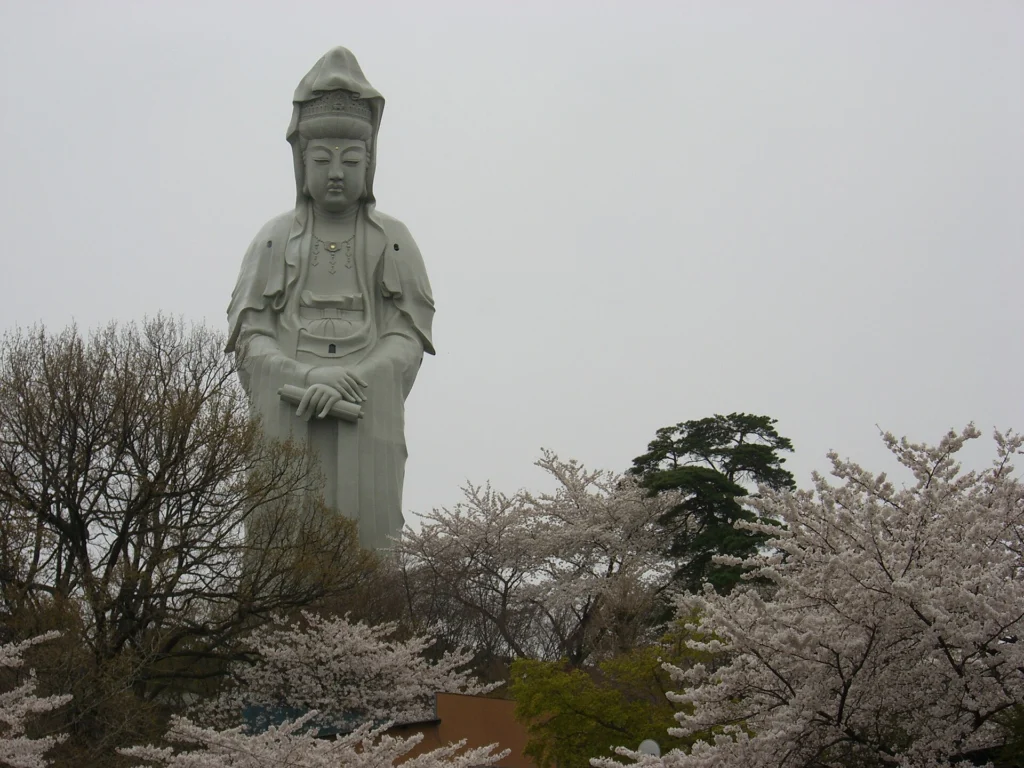
Takasaki Byakui Dai-Kannon is a large white statue of Kannon, the Buddhist figure of mercy. It stands on top of Mt. Kannon (Kannonyama), a hill on the west side of Takasaki, Gunma. A local businessman, Inoue Hozaburo, built it in 1936. The statue is 41.8 m tall and is made of concrete. You can go inside and climb 146 steps to the height of its shoulders. It belongs to Jigenin, a temple of the Koyasan Shingon school of Buddhism.
Quick answer
A 41.8 m concrete statue of Kannon that you can climb inside, at Jigenin Temple.
Hours: March to October: 9:00 to 17:00. November to February: 9:00 to 16:30. You can see the statue from outside at any time. Admission: High school students and older 300 yen; junior high school students and younger 100 yen. Free with a disability certificate. Closed: The inside is closed on the day of the winter solstice for the yearly cleaning (the next Monday if it falls on a weekend), and sometimes in very bad weather.
Quick facts
| What it is | A 41.8 m concrete statue of Kannon that you can climb inside, at Jigenin Temple |
| Hours (inside the statue) | March to October: 9:00 to 17:00. November to February: 9:00 to 16:30. You can see the statue from outside at any time |
| Admission (inside the statue) | High school students and older 300 yen; junior high school students and younger 100 yen. Free with a disability certificate |
| Closed | The inside is closed on the day of the winter solstice for the yearly cleaning (the next Monday if it falls on a weekend), and sometimes in very bad weather |
| Address | 2710-1 Ishihara-machi, Takasaki, Gunma |
| Nearest station | Takasaki Station (West Exit), then the Gururin city bus, Kannonyama Line, about 20 minutes |
| From Tokyo | Joetsu or Hokuriku Shinkansen from Tokyo Station to Takasaki, about 50 minutes, then bus |
| Last checked | November 2026 |
What to see
- The statue: Byakui means “white-robed”. The statue is 41.8 m tall and weighs 5,985 tons. It was built in 1936 and has been repaired twice. It is a national Registered Tangible Cultural Property (since 2000).
- Inside the statue: there are nine floors with 20 Buddhist statues and figures of famous monks. You climb 146 steps to the shoulder level (9th floor). Each floor has small windows with views of Takasaki, the Kanto Plain and the Jomo Sanzan (Gunma’s three well-known mountains).
- Senbon Kannon-do (main hall): the temple’s main hall, built in 1986 for the statue’s 50th year. It holds a thousand small Kannon statues given by a thousand donors.
- Other halls: the Daishi-do hall for Kobo Daishi (the founder of Shingon Buddhism), the six-sided Koon-do hall behind the statue, and an arched bridge (taikobashi).
- Seasons: the temple says there are about 3,000 cherry trees on the hill, with different flowers through the year.
- Painted sliding doors: the Goshiki Ryuo (five-colored dragon kings) fusuma paintings are shown to the public for free twice a year, for about a week. Check the temple’s news page for the dates.
How long to spend
- Inside the statue: the temple says it takes about 15 minutes if you can climb stairs easily.
- With the grounds: add time for the main hall, the other halls and the walk along the approach street with souvenir shops from the Kannonyama-cho bus stop (about 10 minutes on foot).
Before you go
- Stairs only: there is no elevator in the statue or the halls. The temple is on a hill with many slopes and steps.
- Winter solstice: every year on the day of the winter solstice (around December 22), all counters and the inside of the statue are closed for cleaning.
- Parking: there is no parking at the temple. The Kannonyama summit parking lot is free (since April 2025) and open from 9:00 to 17:00, when its gate closes. Do not park on the road.
- Goshuin: temple stamps (goshuin) and charms are available every day during the same hours as the inside of the statue.
Getting there from Tokyo
- Train to Takasaki: the Takasaki Tourism Association says the Joetsu and Hokuriku Shinkansen take about 50 minutes from Tokyo Station to Takasaki Station.
- Bus: from the West Exit of Takasaki Station, take the Gururin city bus, Kannonyama Line (the Kataoka-first route). It takes about 20 minutes. Get off at Kannonyama-cho and walk about 10 minutes along the shop street, or ride one more stop to Byakui Kannon-mae, about 2 minutes on foot.
- Car: about 20 minutes from Takasaki IC or Maebashi IC on the Kan-etsu Expressway.
From Takasaki, you can also visit the Tomioka Silk Mill or go on to Ikaho Onsen. Read our temple etiquette guide before you visit, and find more day trips from Tokyo.
FAQ
Can you go inside the Takasaki Kannon statue?
Yes. You can climb 146 steps inside the statue to the height of its shoulders (9th floor). There are 20 Buddhist statues inside and windows on each floor. It costs 300 yen for high school students and older.
What are the opening hours?
The inside of the statue is open from 9:00 to 17:00 from March to October and from 9:00 to 16:30 from November to February. You can see the statue from outside at any time.
How do I get to the Takasaki Byakui Kannon from Tokyo?
Take the Joetsu or Hokuriku Shinkansen to Takasaki Station (about 50 minutes). From the West Exit, take the Gururin bus, Kannonyama Line, for about 20 minutes to Kannonyama-cho or Byakui Kannon-mae.
Is there an elevator?
No. There is no elevator inside the statue or in the temple halls, and the temple is on a hill with slopes and steps.
When is it closed?
The inside of the statue is closed on the day of the winter solstice for cleaning, or the next Monday if that day is a Saturday or Sunday. It can also close in very bad weather, such as a big typhoon or heavy snow.
Keep reading
Also nearby: Shorinzan Daruma-ji.
Sources
Facts come from the official website of Jigenin Temple (Takasaki Byakui Dai-Kannon) and the Takasaki Tourism Association. They are based on official sources, not our own visit. Hours, fees, bus routes and parking can change, so check before you go. Last checked: November 2026 (on November 15, 2026).
- Takasaki Byakui Dai-Kannon Jigenin (official): Home, visiting hours, fees and access (Japanese)
- Takasaki Byakui Dai-Kannon Jigenin (official): About the temple and the statue (Japanese)
- Takasaki Byakui Dai-Kannon Jigenin (official): FAQ (Japanese)
- Takasaki Tourism Association (official): Access to Takasaki (English)
Also nearby: Takasaki guide