Researched guide · Checked on Oct 21, 2026
Steam rising from a field of wooden channels in the middle of town, the smell of sulfur, and people singing as they stir scalding water with long paddles: Kusatsu is one of Japan’s most famous hot spring towns. It sits about 1,200 meters up in the mountains of Gunma, roughly three hours from Tokyo, and its very acidic water is said to be good for tired bodies. Here is how to get there and where to bathe.
Quick answer
Getting there: limited express Kusatsu-Shima from Ueno to Naganohara-Kusatsuguchi (about 2 hours 20–35 minutes), then a JR bus (25 minutes).
Must-sees: the Yubatake hot spring field and the yumomi water-stirring show at Netsunoyu (¥700).
Day baths: three public bathhouses, ¥800–¥1,200, or ¥2,100 for a pass to all three. They do not specifically refuse guests with tattoos.
Affiliate link
The Yubatake
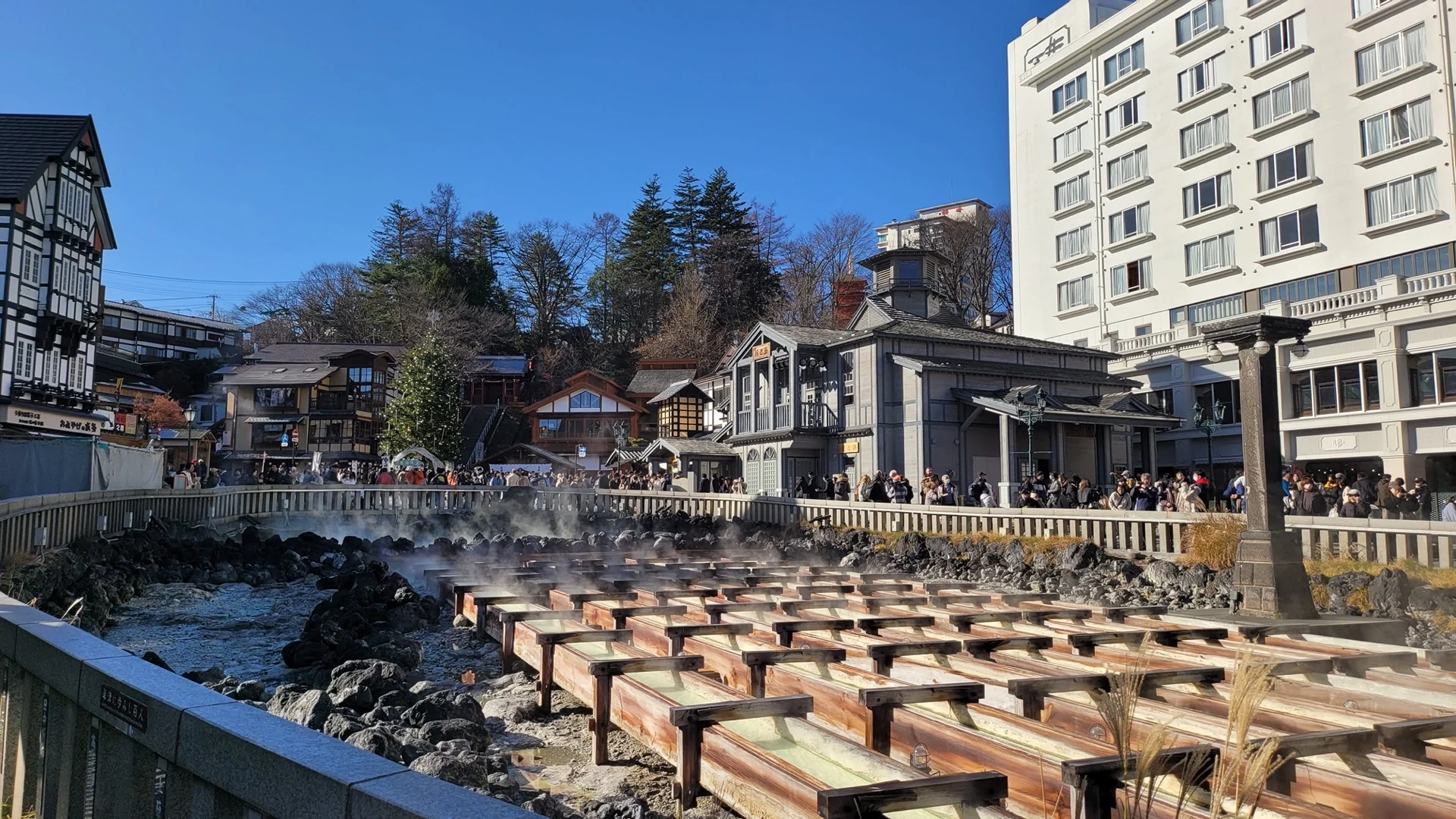
The Yubatake (“hot water field”) is the heart of Kusatsu: a huge source of spring water that flows through rows of wooden channels, cooling as it goes, in the middle of the town. JR East describes Kusatsu as having Japan’s largest natural flow of hot spring water. The square around it was designed by the artist Taro Okamoto, and the old streets spread out from here. It is lit up at night, so come back after dark.
Yumomi show at Netsunoyu
Kusatsu’s water comes out very hot. The traditional way to cool it without adding cold water is yumomi: stirring it with long wooden boards, often while singing a folk song. At Netsunoyu, right next to the Yubatake, you can watch a show of yumomi and dance.
| Details | |
|---|---|
| Show times | 9:30, 10:00, 10:30, 15:30, 16:00, 16:30 (an extra show runs 15:00–15:30 on some days) |
| Price | Adults ¥700, elementary school children ¥350 |
| Tickets | On sale 30 minutes before each show |
| Try it yourself | Yumomi experience ¥300 (elementary school age and up), 11:30–12:50. Check the official calendar for dates |
Three day-trip baths
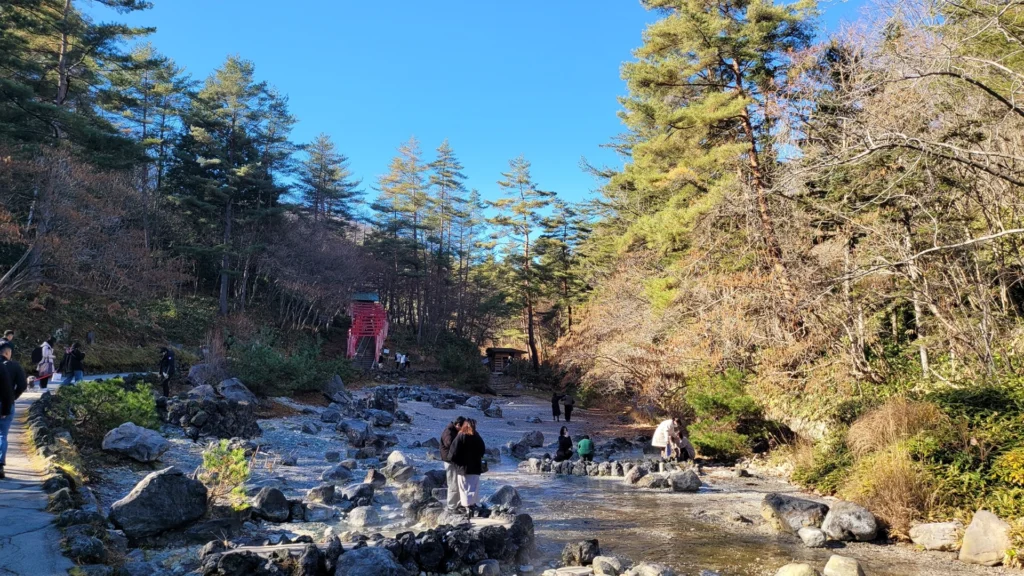
You don’t need to stay overnight to bathe in Kusatsu water. The town runs three public bathhouses, all with free-flowing spring water. Kusatsu’s water is strongly acidic, about pH 2.05.
| Bath | Good for | Hours | Adult price |
|---|---|---|---|
| Sainokawara Open-Air Bath | A large outdoor bath in a park of steaming streams | Apr–Nov 7:00–20:00, Dec–Mar 9:00–20:00 (last entry 19:30) | ¥800 |
| Gozanoyu | A wooden bathhouse beside the Yubatake, with yukata rental | Apr–Nov 7:00–21:00, Dec–Mar 8:00–21:00 (last entry 20:30) | ¥900 |
| Otakinoyu | Several baths and the chance to try baths at different temperatures | 9:00–21:00 (last entry 20:00) | ¥1,200 |
- Pass for all three: the Choina Sanyu Meguri Tegata costs ¥2,100 for adults (¥1,050 for children), one visit to each bath, with no expiry date. Buy it at any of the three.
- Towels: bring your own, or buy one at Sainokawara or Gozanoyu (face towel ¥380). Otakinoyu rents towel sets (¥250) and yukata (¥300).
- Yukata walk: Gozanoyu rents yukata with geta sandals and a basket for strolling around town, ¥2,500 for 3 hours (reception 9:00–17:00).
- Cloudy water day: Otakinoyu has milky-white water on the 2nd and 4th Saturday of each month.
- Mixed bathing: on Fridays from 17:30 to 20:00 (except some dates), the men’s outdoor bath at Sainokawara becomes mixed. Men are lent a bathing wrap for free; women can rent one for ¥400 or wear a swimsuit. The women’s outdoor bath stays women-only.
- Tattoos: the three baths say they do not specifically refuse guests with tattoos. Follow the usual bathing manners.
How to bathe in Kusatsu water
The official bathhouses give this advice for the hot, acidic water:
- Pour hot water over your head and neck before getting in.
- Start with a half-body soak, and keep your first bath to about 5–10 minutes.
- Don’t bathe after drinking alcohol, right after eating, or straight after exercise.
- Bathe no more than three times a day.
- Rinse only lightly afterwards. Sulfur can weaken fabric, so a yukata is a good choice after bathing. Metal parts on swimsuits may change color.
- Drink water and rest for 30 minutes to an hour after bathing.
New to onsen? Read our onsen and sento etiquette guide first.
Getting there from Tokyo
| Route | Time | Notes |
|---|---|---|
| Limited express Kusatsu-Shima from Ueno to Naganohara-Kusatsuguchi, then JR bus | About 2 hours 20–35 minutes by train, plus 25 minutes by bus | All seats reserved. Some trains start from Tokyo Station on certain days |
| Hokuriku Shinkansen from Tokyo to Karuizawa, then bus | About 1 hour 10 minutes by train, plus 1 hour 18–55 minutes by bus | Combine with a stop in Karuizawa |
| Highway bus (Joshu Yumeguri-go) from Tokyo Station or Busta Shinjuku | See the operator’s timetable | Arrives at Kusatsu Onsen Bus Terminal |
JR East lists the JR TOKYO Wide Pass among the passes for the Kusatsu-Shima train; see our transport pass guide. Kusatsu is high in the mountains, so expect snow in winter. A day trip is possible, but with about three hours each way, many people stay a night.
Find Kusatsu Onsen tours
Opens the search results in a new tab. Prices and availability are set by each site. Some of these are affiliate links: we may earn a commission at no extra cost to you.
FAQ
How long does it take to get from Tokyo to Kusatsu Onsen?
About three hours. Take the limited express Kusatsu-Shima from Ueno to Naganohara-Kusatsuguchi (about 2 hours 20–35 minutes), then a JR bus (25 minutes).
Can I visit Kusatsu Onsen as a day trip?
Yes. The three public baths are open to day visitors, but with about three hours each way, many people stay overnight.
Can people with tattoos bathe in Kusatsu?
The town’s three public baths (Otakinoyu, Gozanoyu and Sainokawara) say they do not specifically refuse guests with tattoos. Rules at hotels and other baths vary.
What is yumomi?
A traditional way to cool very hot spring water by stirring it with long wooden boards. You can watch a show at Netsunoyu (¥700) next to the Yubatake.
Related Articles
Sources
Hours, prices and bathing advice come from the official site of Kusatsu’s three public baths, Netsunoyu’s official page, the Kusatsu Onsen Tourism Association and JR East (checked October 21, 2026).