Researched guide · Last checked: Nov 15, 2026
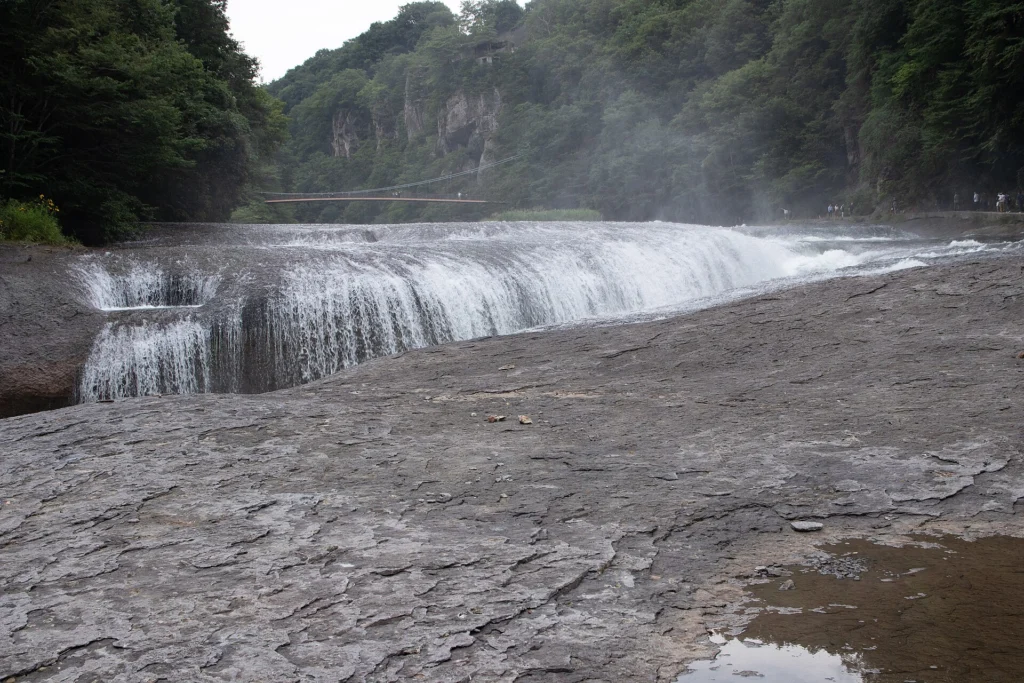
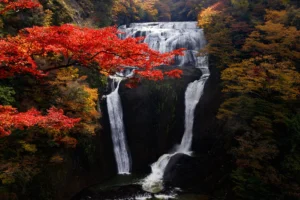
Fukiware Falls (Fukiware no Taki) is a waterfall on the Katashina River in Numata, Gunma. It is 7 m high and 30 m wide, and is sometimes called the “Niagara of the Orient”. The river wore away soft parts of the rock bed and made many cracks, so the rock looks as if it was blown apart. That is where the name comes from: fuki means “blow” and ware means “split”. A path along the gorge passes smaller falls, rock walls and a small temple on an island. It is a national Natural Monument and Place of Scenic Beauty.
Quick answer
A wide waterfall in a rocky river gorge, with a walking path and viewing platforms.
Hours: Open-air area. The path is closed at night. Admission: Free. Parking lots nearby charge a fee. Closed: Mid-December to late March (winter closure). From November 6, 2026, the mountain-side (Takatoya side) path is closed until further notice; the riverside (Okkai side) path is open.
Quick facts
| What it is | A wide waterfall in a rocky river gorge, with a walking path and viewing platforms |
| Hours | Open-air area. The path is closed at night |
| Admission | Free. Parking lots nearby charge a fee |
| Closed | Mid-December to late March (winter closure). From November 6, 2026, the mountain-side (Takatoya side) path is closed until further notice; the riverside (Okkai side) path is open |
| Address | Okkai, Tone-machi, Numata, Gunma |
| Nearest station | Numata Station (JR Joetsu Line), then bus about 40 minutes; or Jomo-Kogen Station (Joetsu Shinkansen), then bus about 70 minutes |
| From Tokyo | Joetsu Shinkansen from Tokyo to Jomo-Kogen, then bus |
| Last checked | November 2026 |
What to see
- Fukiware Falls: water drops 7 m into a long crack in the rock, across a width of 30 m. Numata City says the cracks took about 10,000 years to form. A local legend says the pool below the falls leads to Ryugu, a palace under the water.
- Masutobi Falls: a smaller waterfall downstream. Its name means “trout-jumping falls”: long ago, trout came up the river but could not jump over this step.
- Hannya-iwa: a tall rock wall said to look like a hannya, a demon mask used in Noh theater. Many rock walls tens of meters high stand around it.
- Ukishima Kannon-do: a small Kannon hall on an island (Ukishima) in the river. The present hall was rebuilt in 1984 in nearly the original form. It holds a Kannon statue said to be the work of Hidari Jingoro, the carver linked to the Sleeping Cat at Nikko Toshogu.
- Bridges and viewing platforms: Ukishima Bridge and Fukiware Bridge cross the river. Further on, three viewing platforms (kanbakudai) look down on the falls.
How long to spend
- Full path: Numata City says a walk around the gorge, including the path, takes about 1 hour.
- Seasons: autumn leaves are usually at their peak from late October to early November. From April to June, melting snow makes the falls stronger.
Before you go
- Path closure (from November 6, 2026): the mountain-side (Takatoya side) path is closed for a safety survey until further notice. The riverside (Okkai side) path is open as usual.
- Winter closure: the area is closed from mid-December to late March. The path is also closed at night.
- No fences: to protect the view, there are no fences along the path. The path from Masutobi Falls to Fukiware Falls is narrow and can be slippery after rain. Wear shoes with a good grip.
- Stay behind the white line: people have died after falling here. Do not cross the white lines or ropes, and do not use your phone while you walk.
- Parking: seeing the falls is free, but the parking lots nearby have three different types of fees.
Getting there from Tokyo
- Shinkansen: take the Joetsu Shinkansen from Tokyo to Jomo-Kogen Station. From there, the bus to the falls takes about 70 minutes.
- Via Numata: from Numata Station on the JR Joetsu Line, the bus takes about 40 minutes.
- Bus company: the buses are run by Kan-etsu Kotsu. Check its timetable and fares before you go.
- Car: from Numata IC on the Kan-etsu Expressway, drive on Route 120 toward Oze for about 20 minutes.
For more waterfalls, see Kegon Falls in Nikko or Fukuroda Falls in Ibaraki. Gunma’s hot spring towns include Kusatsu Onsen. Find more day trips from Tokyo.
FAQ
How do I get to Fukiware Falls from Tokyo?
Take the Joetsu Shinkansen to Jomo-Kogen Station, then a bus to the falls (about 70 minutes). You can also go to Numata Station on the JR Joetsu Line and take a bus for about 40 minutes.
Is Fukiware Falls free?
Yes. Seeing the falls is free. The parking lots nearby charge a fee.
Can I visit Fukiware Falls in winter?
No. The area is closed from mid-December to late March. The path is also closed at night all year.
When should I visit Fukiware Falls?
Autumn leaves are usually at their peak from late October to early November. From April to June, melting snow makes the water flow stronger.
Is the path safe?
There are no fences, and parts of the path are narrow and slippery. Wear good shoes, stay behind the white lines and do not walk while using your phone. From November 6, 2026, the mountain-side path is closed, but the riverside path is open.
Keep reading
Sources
Facts come from Numata City’s official pages on Fukiware Falls. They are based on official sources, not our own visit. Path closures, the winter closure dates and bus times can change, so check before you go. Last checked: November 2026 (on November 15, 2026).
- Numata City (official): Fukiware Falls, introduction (Japanese)
- Numata City (official): Fukiware Falls, sights along the path (Japanese)
- Numata City (official): Fukiware Falls, FAQ (Japanese)
- Numata City (official): Access to Fukiware Falls (Japanese)
- Numata City (official): Partial path closure from November 6, 2026 (Japanese)