Researched guide · Last checked: Nov 15, 2026
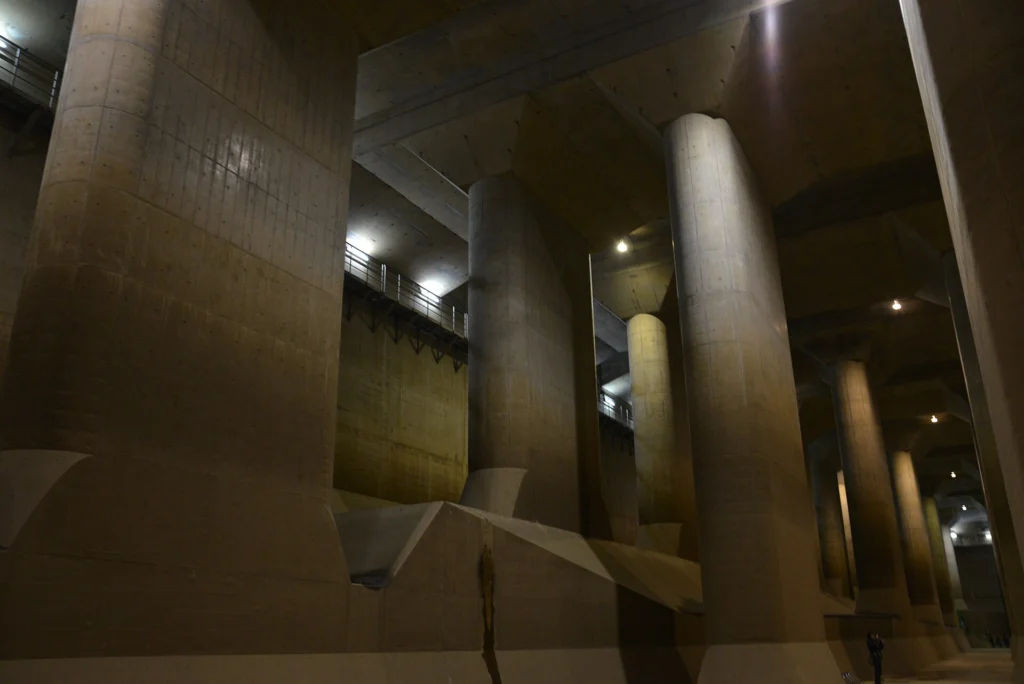
The Metropolitan Area Outer Underground Discharge Channel, often called G-Cans, is a flood control system in Kasukabe, Saitama. When rivers flood, it carries water through an underground tunnel and pumps it out to the Edo River. Its signature part is the pressure-adjusting water tank, a huge room 22 m underground with 59 giant pillars. Because of how it looks, it is called the “underground temple”. You can only go underground on a guided tour, and you must book in advance. The free Ryu-Q-kan exhibition hall is open without booking.
Quick answer
A national flood control facility with an underground water tank you can see on a guided tour.
Hours: Ryu-Q-kan exhibition hall: 9:30 to 16:30. Tours run at set times (advance booking only). Admission: Ryu-Q-kan free. Tours from 1,200 yen per person (Underground Temple course, about 55 minutes). Closed: Ryu-Q-kan: Mondays and the New Year holidays (on Mondays, only tour guests can enter).
Quick facts
| What it is | A national flood control facility with an underground water tank you can see on a guided tour |
| Hours | Ryu-Q-kan exhibition hall: 9:30 to 16:30. Tours run at set times (advance booking only) |
| Admission | Ryu-Q-kan free. Tours from 1,200 yen per person (Underground Temple course, about 55 minutes) |
| Closed | Ryu-Q-kan: Mondays and the New Year holidays (on Mondays, only tour guests can enter) |
| Address | 720 Kamikanasaki, Kasukabe, Saitama |
| Nearest station | Minami-Sakurai Station (Tobu Urban Park Line), north exit, about 25 to 30 minutes on foot (about 2.3 km) |
| From Tokyo | Tobu Urban Park Line to Minami-Sakurai Station, then walk, take a taxi (about 7 minutes) or the Haru-bus community bus |
| Last checked | November 2026 |
What to see
- The “underground temple”: the pressure-adjusting water tank slows down the water that flows in from the tunnel, so pumps can send it to the Edo River smoothly. It is 22 m underground, 177 m long, 78 m wide and 18 m high.
- The pillars: 59 pillars hold up the roof. Each one is 7 m deep, 2 m wide and 18 m high, and weighs about 500 tons.
- A field on top: the roof of the tank is a soccer field above ground, so you can get a feel for its size from outside too.
- Ryu-Q-kan: the free exhibition hall explains the system, floods and rivers. You can use it without booking.
Tours and booking
- Book in advance: all underground visits are guided tours and need a booking. Same-day booking is not possible.
- When booking opens: for individuals, online booking opens at 0:00 on the same date one month before the tour, and closes at 23:59 the day before.
- Courses: there are seven courses, and all of them visit the underground temple. The Underground Temple course takes about 55 minutes and costs 1,200 yen. The Shaft course (about 110 minutes, 3,500 yen) adds a walk around the 70 m deep first shaft with a harness and helmet.
- Cancelling: cancelling is free until 3 days before. From 2 days before, you pay 100%.
- Book on the official site: book through the official tour website, linked in the sources below.
Before you go
- Japanese only: tours are explained in Japanese only. The organizer suggests bringing someone who can interpret.
- About 100 steps: every course has about 100 steps up and down, with no elevator or escalator. You need to be able to walk on your own.
- Age rules: children who have not started elementary school cannot join, even with an adult. Children of junior high school age or younger need an adult (up to 5 children per adult).
- Clothes: the tank is about 20°C in summer and about 10°C in winter. Floors can be wet and slippery. Wear sneakers; high heels, beach sandals and shoes without backs are not allowed.
- No toilet break: use the toilet before the tour starts. Check in at least 10 minutes before your tour.
- After heavy rain: when the system is working, the tour course changes. After water has flowed in, the tank and shaft stay closed for about a week for safety.
Getting there from Tokyo
- Train: the nearest station is Minami-Sakurai on the Tobu Urban Park Line (Tobu Noda Line). From the north exit, it is about 25 to 30 minutes on foot.
- Taxi: about 7 minutes (around 1,300 yen) from the north exit of Minami-Sakurai Station. Taxis are often not waiting at the station, so leave extra time. Taxis are more often waiting at the east exit of Kasukabe Station, about 20 minutes away by car.
- Community bus: the Haru-bus runs from Minami-Sakurai Station to the Ryu-Q-kan stop, but only on some days and at some times. It does not run on Sundays.
- Car: free parking for about 50 cars. Enter the address “720 Kamikanasaki, Kasukabe” in your car navigation, as the facility name may not show the right place.
If you like big engineering, visit the Railway Museum in Saitama or the underground quarry at the Oya History Museum. In Tokyo, the Tokyo Waterworks Historical Museum tells the story of the city’s water. Find more day trips from Tokyo.
FAQ
Do I need to book a G-Cans tour?
Yes. All underground visits are guided tours that need a booking. Same-day booking is not possible. For individuals, booking opens one month before the tour date.
How much is the G-Cans tour?
The Underground Temple course costs 1,200 yen per person and takes about 55 minutes. Other courses cost more, such as the Shaft course at 3,500 yen.
Are G-Cans tours in English?
No. The official tour site says tours are in Japanese only. It suggests bringing someone who can interpret.
Can children join the tour?
Children who have not started elementary school cannot join. Children of junior high school age or younger need to come with an adult.
How do I get to G-Cans?
Take the Tobu Urban Park Line to Minami-Sakurai Station. From the north exit, walk about 25 to 30 minutes or take a taxi for about 7 minutes.
Keep reading
Sources
Facts come from the official G-Cans tour website and the Edogawa River Office of the Ministry of Land, Infrastructure, Transport and Tourism, which runs the facility. They are based on official sources, not our own visit. Tour courses, prices and bus times can change, and tours can change after heavy rain, so check before you go. Last checked: November 2026 (on November 15, 2026).
- Metropolitan Area Outer Underground Discharge Channel tours (official): Courses (Japanese)
- Metropolitan Area Outer Underground Discharge Channel tours (official): FAQ (Japanese and English)
- MLIT Edogawa River Office (official): Pressure-adjusting water tank (Japanese)
- MLIT Edogawa River Office (official): Ryu-Q-kan (Japanese)
- MLIT Edogawa River Office (official): Access map (Japanese)