In late December, Tokyo changes. Pairs of pine and bamboo appear at building entrances, straw ropes hang on doors, and round rice cakes sit in homes. These are the New Year decorations. This guide explains the three main ones, what they mean, when they go up and come down, and where the sources do not agree.
Quick answer
Japan’s three main New Year decorations are kadomatsu (門松, pine and bamboo at the entrance), shimekazari (しめ飾り, a straw-rope ornament) and kagami mochi (鏡餅, two stacked rice cakes). They welcome the New Year deity, Toshigami (年神様). One shrine says to put them up on December 28 or 30, and to avoid the 29th and the 31st. They usually come down at the end of matsu no uchi (松の内, “the time of the pine”), which one shrine gives as January 7. The mochi is eaten on January 11.
These are mainly home and shop customs, and dates vary by region and by place. Check with the place or shrine near you before you go.
- Overview
- Why Japan Decorates for the New Year
- Kadomatsu: The Pine and Bamboo at the Door
- Shimekazari: The Straw-Rope Ornament
- Kagami Mochi: The Offering Inside
- When Do They Go Up?
- When Do They Come Down?
- Kagami Biraki: Breaking and Eating the Mochi
- What Happens to the Decorations Afterward?
- Tips for Visitors in Tokyo
- What We Could Not Confirm
- FAQ
- Keep reading
- Sources
Overview
| What they are | Seasonal decorations that welcome the New Year deity, Toshigami |
| Main three | Kadomatsu (entrance), shimekazari (door or gate), kagami mochi (inside the home) |
| Put up | December 28 or 30 (one shrine’s guidance). Avoid the 29th and the 31st |
| Taken down | End of matsu no uchi: January 7 in recent practice per one shrine. It varies by region |
| Kagami biraki | January 11 (the mochi is broken and eaten) |
| Where to see them in Tokyo | Shop and building entrances, homes and shrines from late December. Not a ticketed event |
| Cost to see them | Free on the street. Prices for buying them are not covered here |
| Last checked | November 2026 (on November 17, 2026) |
Why Japan Decorates for the New Year
The decorations are made to welcome Toshigami (年神様), the deity who is believed to visit homes at the New Year. A shrine in Niigata, Hakusan Jinja, says New Year decorations are markers that welcome this deity. The decorations are not just for looks. Each one has a job: a place for the deity to arrive, a clean space for it to stay, and an offering.
For the bigger picture of the New Year holiday, see our guide to Japanese New Year customs.
Kadomatsu: The Pine and Bamboo at the Door
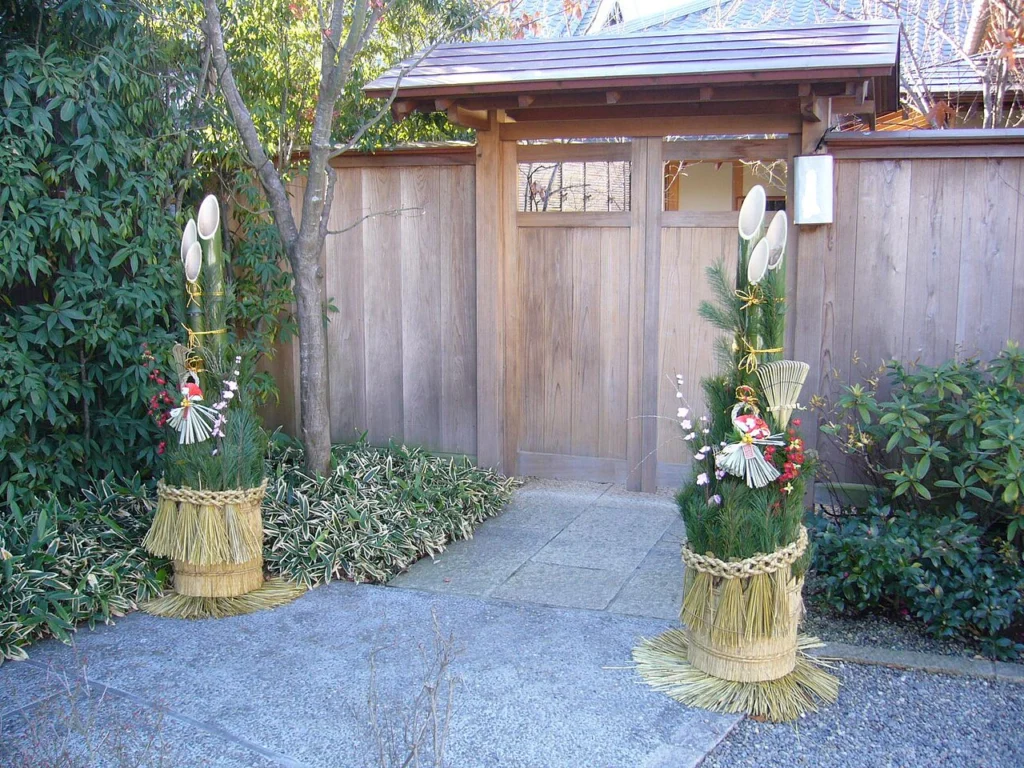
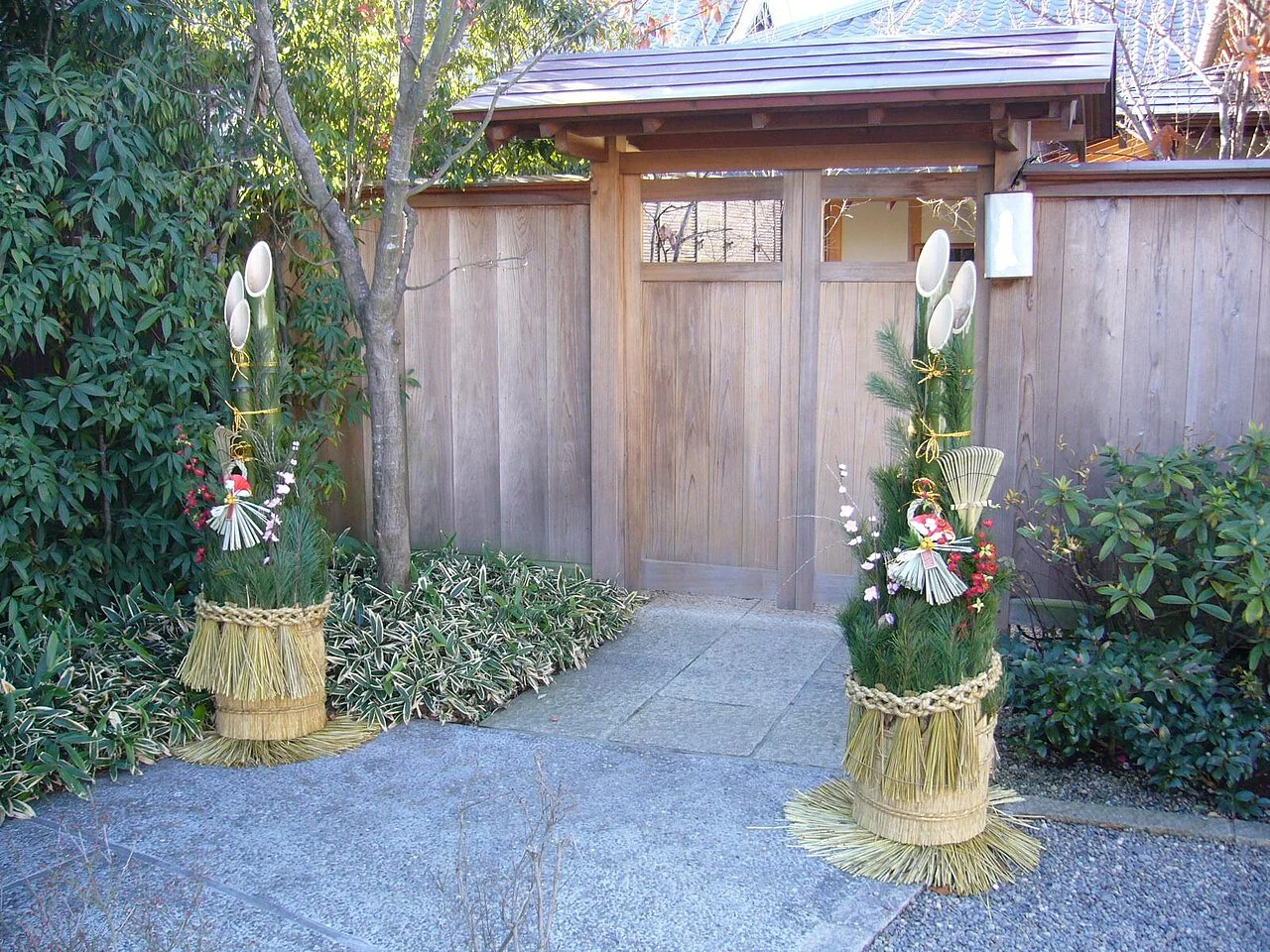
Kadomatsu (門松, “gate pine”) is made of pine branches and bamboo. The Japan National Tourism Organization (JNTO) says it uses three bamboo pieces combined with pine branches, and that it usually stands in front of buildings. Hakusan Jinja says it is set up in pairs at the entrance. The shrine explains that a deity is believed to dwell in pine, and that bamboo stands for long life.
JNTO says kadomatsu are displayed roughly between January 1 and 7. Shrine guidance gives December 28 or 30 as the day to put decorations up, so you will often see them before January 1. If you walk Tokyo in the last days of December, look at the entrances of department stores, hotels, restaurants and theaters.
Shimekazari: The Straw-Rope Ornament
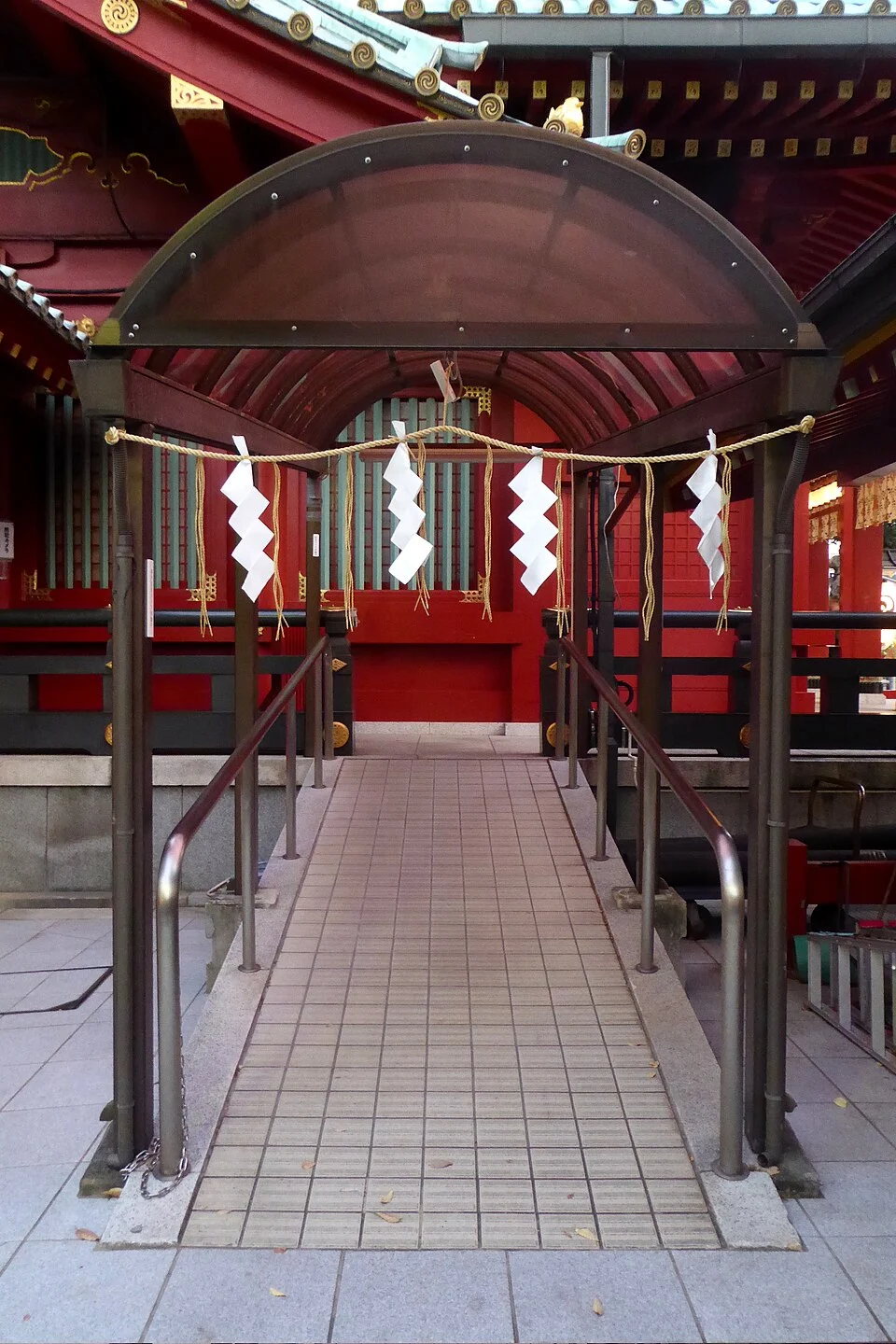
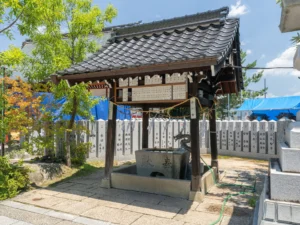
Shimenawa (しめ縄) is a straw rope. Shimekazari (しめ飾り) is the New Year ornament made from it. Hakusan Jinja says shimenawa and shimekazari show a clean space that welcomes the gods and separates it from outside impurity, so that misfortune does not come in. You can see plain shimenawa at shrines all year, such as the one in the photo below at Kanda Myojin in Tokyo.
We did not find an official page that lists the many shapes and regional styles of shimekazari, so we do not describe them here. You can see them on doors, gates and shop fronts in late December. For shrine manners and how to behave there, read our shrine and temple etiquette guide.
Kagami Mochi: The Offering Inside
Kagami mochi (鏡餅, “mirror rice cake”) is two round rice cakes stacked together, with a daidai (橙, bitter orange) on top. The Ministry of Agriculture, Forestry and Fisheries (MAFF) says the custom of offering it began in the Muromachi period, and that it is an offering for Toshigami. Hakusan Jinja describes it as a place where the deity’s spirit stays. JNTO says it is placed in the tokonoma (床の間, the alcove of a room) inside homes.
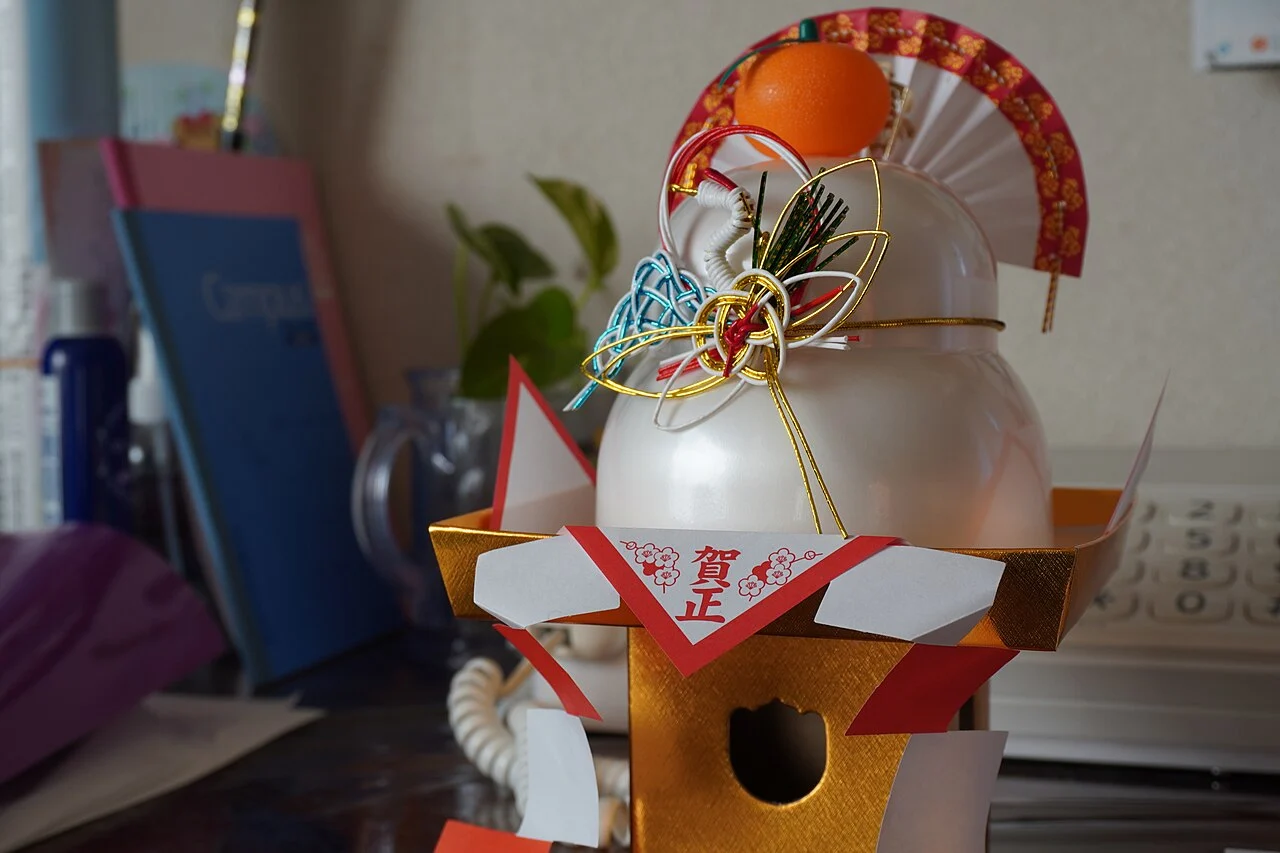
MAFF explains what each part means:
| Part | Meaning (MAFF) |
|---|---|
| Two round cakes | The sun and the moon, and good luck that builds up |
| Daidai (bitter orange) | A family that continues for generations |
| Urajiro (fern leaves) | Old leaves stay while new ones grow, so life and long life |
| Yuzuriha (leaves) | Passing things down from one generation to the next |
MAFF also says it is called a “mirror” because the round shape looks like old bronze mirrors.
When Do They Go Up?
The clearest guidance we could open comes from Hakusan Jinja. It says to put up decorations on December 28 or 30, and to put kagami mochi out on those days too. It says the 29th is customarily avoided because it is linked to suffering. It also says decorating on December 31 is called ichiya kazari (一夜飾り, “one-night decoration”) and is seen as disrespectful, because welcoming a deity in one night is not sincere.
Some Japanese guides say preparations start around December 13. We could not confirm that on an official page, so treat it as unconfirmed. Timing also varies by region and by family. If you want to see decorations going up, late December is the safest time to look.
When Do They Come Down?
| What | Date given | Source |
|---|---|---|
| Matsu no uchi (decoration period) ends | January 7 in recent practice. In the past, January 15 | Hakusan Jinja (Niigata) |
| Kadomatsu on display | Roughly January 1 to 7 | JNTO |
| Kagami biraki (breaking and eating the mochi) | January 11 | MAFF and Hakusan Jinja |
| Dondo yaki (burning old decorations at a shrine) | Held around January 15 at this shrine | Hakusan Jinja |
Matsu no uchi literally means “inside the pine,” the time when the pine decoration is up. The end date varies by region. The shrine we read gives January 7 for recent practice and January 15 for the older custom. We could not confirm the Kansai dates on an official page, so check locally.
Kagami Biraki: Breaking and Eating the Mochi
Kagami biraki (鏡開き, “opening the mirror”) takes place on January 11. MAFF says people take down the offering and eat it, praying for good health. It says that pointing a blade at an offering is bad luck, so the mochi is broken by hitting it, not cut. Because “to break” (割る) is also seen as unlucky, the word “to open” (開く) is used instead. MAFF stresses that the mochi should be eaten, not thrown away, as it is believed to hold the power of the deity.
What Happens to the Decorations Afterward?
Decorations are not kept for the next year. JNTO says they are taken to local Shinto shrines and burned in a ritual called dondo yaki (どんど焼き). It adds that throwing out old charms at home is believed to bring bad luck. Hakusan Jinja says people bring old charms, shimekazari and kadomatsu to be burned at the shrine.
As a visitor, note that shrines do not all accept the same things. Meiji Jingu’s page says its old-charm drop-off accepts ofuda (paper charms), omamori (charms), arrows and ema (wooden wishing plaques), but not New Year decorations. Kodaira Shinmeigu, a shrine in Tokyo, says to bring shimekazari to the temporary drop-off set up for its dondo yaki, and to remove paper and plastic wrapping. Because these rules differ by shrine, call or check the shrine’s site first. For what the charms are, see our guide to omamori, omikuji and ema.
Tips for Visitors in Tokyo
- Look at entrances. Hotels, department stores, restaurants and theaters often put out kadomatsu. Some places may also be closed around the holiday, so check before you go.
- Do not take or touch decorations. They belong to the place and are part of a religious custom.
- Visit a shrine in early January. See our Meiji Jingu guide and Kanda Myojin guide for a shrine visit, and our Senso-ji guide for a temple.
- Plan the dates. Our Tokyo in December and Tokyo in January guides cover the season, and New Year in Tokyo covers the holiday itself.
- Hear the bells. On New Year’s Eve, see our Joya no Kane guide.
What We Could Not Confirm
- The idea that decorations start on about December 13: we found no official page for it, so treat it as not confirmed.
- The end of matsu no uchi and the kagami biraki date in Kansai: no official page opened.
- Which Tokyo shrines accept decorations, and on which days. Meiji Jingu does not accept them. We did not check others.
- The shapes and regional styles of shimekazari.
- The Jinja Honcho (National Association of Shinto Shrines) New Year page was under maintenance (HTTP 503) on November 17, 2026, so it is not used.
FAQ
What are the three main Japanese New Year decorations?
They are kadomatsu (pine and bamboo at the entrance), shimekazari (a straw-rope ornament) and kagami mochi (two stacked rice cakes with a bitter orange). They welcome the New Year deity, Toshigami.
When should New Year decorations be put up?
One shrine, Hakusan Jinja, says December 28 or 30. It says to avoid the 29th and the 31st. Some guides say preparations begin around December 13, but we could not confirm this. Dates vary by region.
When are New Year decorations taken down?
At the end of matsu no uchi. One shrine gives January 7 for recent practice, and January 15 in older custom. It varies by region, so check locally.
What is kagami biraki?
It is the custom of breaking and eating the kagami mochi on January 11. MAFF says it is broken by hitting it, not cut with a knife, and the word “open” is used instead of “break.”
What do you do with old New Year decorations?
They are usually burned at a shrine in a ritual called dondo yaki. Shrines differ: Meiji Jingu’s old-charm drop-off does not accept New Year decorations, so check with the shrine first.
Keep reading

Sources
Last checked: November 2026 (on November 17, 2026). Dates and customs vary by region and by place. Check before you go.
- Hakusan Jinja (Niigata): Koshogatsu, decoration dates and meanings (shrine site, Japanese)
- MAFF: Kagami mochi, its origin and meaning (Ministry of Agriculture, Forestry and Fisheries, Japanese)
- JNTO: Japanese New Year (japan.travel, English)
- Meiji Jingu: Hatsumode, old-charm drop-off (shrine site, Japanese)
- Kodaira Shinmeigu: Returning old charms and decorations (shrine site, Japanese)