Researched guide · Last checked: Nov 15, 2026
Yoyogi Hachimangu is a quiet Shinto shrine on a hill in Shibuya City, about 5 minutes on foot from Yoyogi-Hachiman Station. The shrine says its legend starts in 1212 and that its forest is a rare piece of natural woodland in Shibuya that keeps the look of old Musashino. It also holds a surprise: the remains of a Jomon-period village about 5,000 years old, with a rebuilt pit dwelling in the grounds. The shrine can be visited 24 hours a day.
Quick answer
Yoyogi Hachimangu is a quiet Shinto shrine on a hill in Shibuya City, about 5 minutes on foot from Yoyogi-Hachiman Station.
Hours: Worship is possible 24 hours a day. The shrine office is open 9:00-17:00.
Admission: The official site does not list an entry fee.
Quick facts
| What it is | A Shinto shrine to Emperor Ojin (the god Hachiman), on a hill with an old forest and a Jomon-period site |
| Hours | Worship is possible 24 hours a day. The shrine office is open 9:00-17:00 |
| Admission | The official site does not list an entry fee |
| Address | 5-1-1 Yoyogi, Shibuya City, Tokyo |
| Nearest station | Yoyogi-Hachiman Station (Odakyu Line), about 5 minutes on foot |
| Payment | Cash only at the shrine |
| Last checked | November 2026 |
What to see
- The forest: the shrine’s grove is natural woodland with Japanese chinquapin (sudajii), camphor, zelkova and ginkgo trees. The shrine says birds and insects come with the changing seasons.
- The Yoyogi Hachiman site: a dig in 1950 found pottery, stone tools, the floor of a Jomon-period dwelling and post holes. The shrine says people lived in a village on this 32-meter hill about 5,000 years ago. The dwelling has been rebuilt, and some finds are on show in a display hall next to the kagura hall.
- Large votive paintings: two big ema were given in 1840 and 1841, one of Empress Jingu and one telling the shrine’s history. Shibuya City lists them as folk materials (designated October 1, 1992).
- Stone monuments: a farewell lantern of 1909 from people who moved away when the army made a parade ground where Yoyogi Park is now, a war memorial stone and a haiku stone for the poet Usuda Aro.
- The sacred tree: a camphor tree with a straw rope stands near the shrine office. The shrine asks visitors not to drop coins in its hollow or to hug it for long, to protect the tree.
History
- Who is honored: Emperor Ojin, also called Hachiman. The shrine says he was long honored by the court and by samurai families as a god who guards the nation and drives away evil, and is now known for warding off bad luck.
- 1212: the shrine tells of Arai Geki Tomoaki, a retainer of an aide to the second shogun Minamoto no Yoriie. After Yoriie’s death he lived in the Yoyogi fields as a monk named Soyu. On the night of August 15, 1212, he had a dream and received a god’s message and a jewel mirror. On September 23 he built a small shrine at the old Moto-Hachiman site and invited the spirit of Tsurugaoka Hachimangu.
- Move to the present site: monks ran the shrine for centuries. The third head priest, Choshu, moved it to its present site, helped by a large donation of land from his aunt, a consort of the Kishu family.
- After the Meiji Restoration: when Shinto and Buddhism were separated, the shrine became a village shrine. Smaller shrines from old Yoyogi Village were added to it.
Plan your visit
- Photos: photos and videos other than for personal use need advance permission. People who book a prayer can have a professional photographer at the hall. Photo-only visits for Shichi-Go-San, coming-of-age or weddings are not allowed, even in the grounds.
- Fuji mound: the shrine says it does not have a Fuji-zuka. A Fuji pilgrimage stone stands next to Shusse Inari Shrine.
- Steps: you can reach the main hall without climbing steps by using the vehicle road.
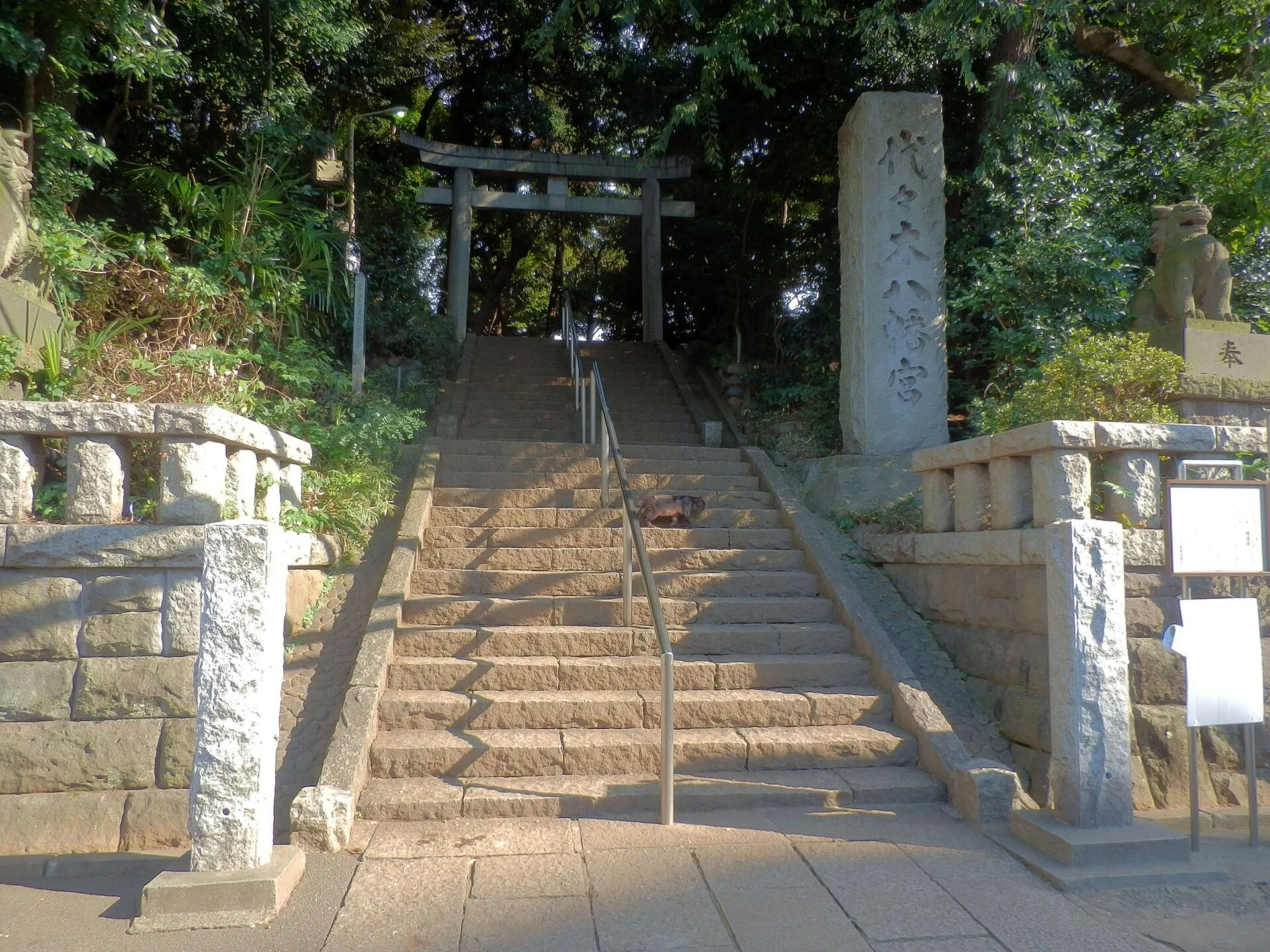
- Toilets: people who book a prayer can use the toilets in the shrine office. Other visitors use the toilets below the stone steps, along Yamate-dori.
- Parking: about 10 spaces inside the grounds, for worshippers only. A micro bus can park, but a large bus cannot.
- Setsubun: on February 3, the shrine holds a ceremony at 3:00 pm and bean-throwing at 3:30 pm, with a last round for children and a Japanese drum offering.
Getting there
- Odakyu Line, Yoyogi-Hachiman Station: about 5 minutes on foot.
- Chiyoda Line, Yoyogi-Koen Station: about 5 minutes from the exit on the Yoyogi-Uehara side.
- Bus from Shibuya Station (south exit): routes Shibu 61 (to Hatsudai), Shibu 63 and 64 (to Nakano) and Shibu 66 (to Asagaya). Get off at Hachiman-shita and walk about 1 minute.
The shrine is close to Yoyogi Park and Meiji Jingu. For more, read our Shibuya guide, shrine and temple etiquette and temples and shrines in Tokyo.
FAQ
Is Yoyogi Hachimangu open at night?
The shrine says visitors can worship at any time, 24 hours a day. The shrine office is open from 9:00 to 17:00.
Can I take photos?
Photos for personal use are fine, but photos and videos for other uses need advance permission. The shrine does not allow photo-only visits for events such as weddings and Shichi-Go-San.
What is the Jomon site?
A site dug in 1950 where a Jomon-period dwelling and post holes were found. The shrine says it dates to about 5,000 years ago, and a dwelling has been rebuilt in the grounds.
Can I pay by card?
No. The shrine takes cash only.
How do I get there?
About 5 minutes on foot from Yoyogi-Hachiman Station (Odakyu Line) or from Yoyogi-Koen Station (Chiyoda Line).
Keep reading

Sources
Facts come from the official Yoyogi Hachimangu website (in Japanese), last checked on November 15, 2026. They are based on official sources, not our own visit. Last checked: November 2026 (on November 15, 2026).
Also nearby: Shinto and nature: sacred forests and trees