Researched guide · Last checked: Nov 14, 2026
The Imperial Palace Outer Garden (Kokyo Gaien) is the wide plaza of lawns and black pines in front of the Imperial Palace. It opened to the public as a national garden in 1949 and is managed by Japan’s Ministry of the Environment. This page covers the outer garden side: Nijubashi, Sakuradamon, the Kusunoki Masashige statue and Wadakura Fountain Park. For the palace’s East Gardens, see our East Gardens page.
Quick answer
Hours: Open at all times (access may be restricted on days of state events)
Admission: Free.
Nearest stations: Nijubashimae (Exit 2 or B6), about 2 minutes; JR Tokyo Station, about 10 minutes.
Quick facts
| Hours | Open at all times (access may be restricted on days of state events) |
| Admission | Free |
| Size | About 115 hectares including the moats and Kitanomaru Park |
| Highlights | Nijubashi, Sakuradamon gate, Kusunoki Masashige statue, Wadakura Fountain Park |
| Nearest stations | Nijubashimae (Exit 2 or B6), about 2 minutes; JR Tokyo Station, about 10 minutes |
| Last checked | November 2026 (on November 14, 2026) |
What to see
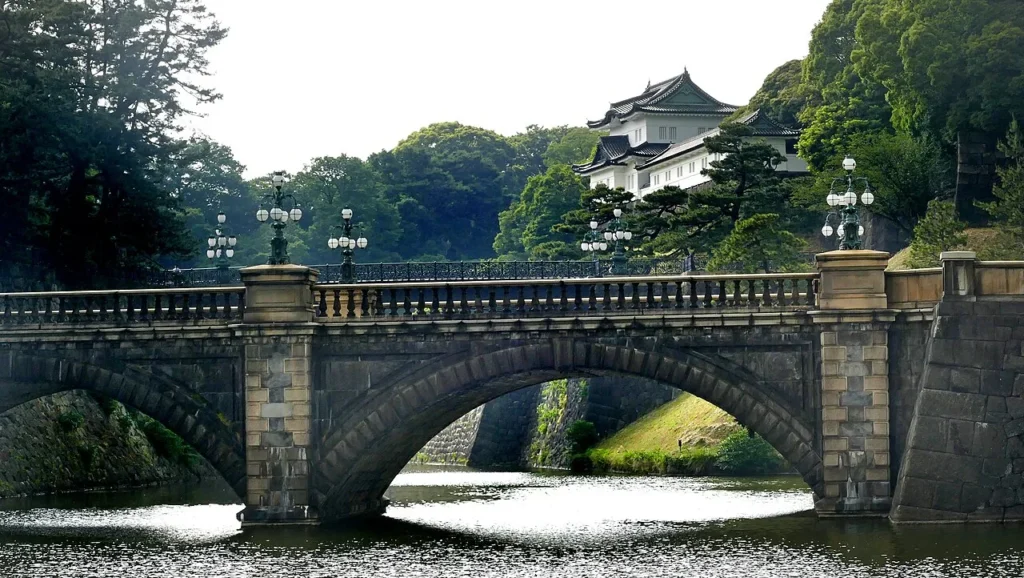
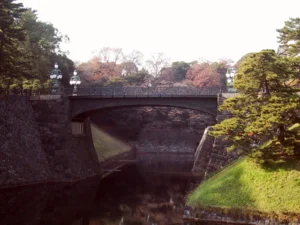
- Nijubashi: two bridges cross the moat to the palace’s main gate: the stone bridge in front (Seimon Ishibashi) and the iron bridge behind it (Seimon Tetsubashi). Strictly, Nijubashi means the iron bridge. The bridges are used only for official events such as the New Year greeting. More in our Nijubashi page.
- Sakuradamon: rebuilt in 1636, with a square courtyard between its two gates. It is the largest surviving gate of this type at Edo Castle and an Important Cultural Property.
- Kusunoki Masashige statue: a mounted samurai on a granite base, completed in 1900. The statue is about 4 m tall, about 8 m with the base.
- The black pines: about 2,000 black pines stand on the great lawn in front of the palace. Planting began in 1888.
- Wadakura Fountain Park: the fountain shoots water 6 m high, and a 5.5 m high, 30 m long water feature was added in 1995. The fountains are lit at night.
In the evening, Sakuradamon, Wadakura Bridge, the Kusunoki statue and parts of the stone walls are lit from 15 minutes after sunset until 21:00.
Tips
- The garden is open at all times, but some areas may be closed on days of state events.
- Rest areas are open 10:00 to 16:00.
- Nijubashi is seen from the plaza. You cannot walk onto the bridges.
- For the castle ruins and gardens inside the walls, go to the East Gardens; they have their own opening hours.
Getting there
- Nijubashimae Station (Tokyo Metro Chiyoda Line): Exit 2 or B6, about 2 minutes.
- Hibiya Station (Toei Mita Line): Exit 2 or B6, about 2 minutes.
- Sakuradamon Station (Tokyo Metro Yurakucho Line): Exit 3, about 8 minutes.
- JR Tokyo or Yurakucho Station: about 10 minutes on foot.
Walk north to Kitanomaru Park, or see the whole area in our Imperial Palace guide.
Also nearby: Hibiya and Yurakucho Guide: Hibiya Park, the Glass Forum and the Palace Plaza
FAQ
Is the Imperial Palace Outer Garden free?
Yes. It is free and open at all times, except when access is restricted for state events.
Can I walk on Nijubashi?
No. The bridges are used only for official events, such as the New Year greeting. You see them from the plaza.
What is the difference between the Outer Garden and the East Gardens?
The Outer Garden is the open plaza in front of the palace. The East Gardens are inside the old castle walls and have their own opening hours.
When are the lights on at night?
From 15 minutes after sunset until 21:00, all year.
Which station is closest?
Nijubashimae Station, Exit 2 or B6, about 2 minutes on foot.
Keep reading
Also nearby: National Diet Building.
Sources
Facts come from the Ministry of the Environment (Kokyo Gaien National Garden) and the National Gardens Association.
- Ministry of the Environment: Kokyo Gaien overview (Japanese)
- Ministry of the Environment: Nijubashi (Japanese)
- Ministry of the Environment: Sakuradamon (Japanese)
- Ministry of the Environment: Kusunoki Masashige statue (Japanese)
- Ministry of the Environment: Black pines (Japanese)
- Ministry of the Environment: Wadakura Fountain Park (Japanese)
- Ministry of the Environment: Visitor information (Japanese)
- National Gardens Association: Access (Japanese)