Researched guide · Last checked: Nov 18, 2026
Arisugawa-no-miya Memorial Park is a free park run by Minato City in Minami-Azabu, about 3 minutes on foot from Hiroo Station. In the Edo period the land held the residences of feudal lords. From 1896 it belonged to the Arisugawa-no-miya imperial family. Prince Takamatsu gave it to Tokyo City in 1934, and it opened as a memorial park the same year. The park uses the hills of the Azabu plateau, with a stream, a waterfall and a pond in a strolling garden (rinsen kaiyu-shiki, a garden of woods and water that you walk around). The Tokyo Metropolitan Central Library stands inside the park.
Quick answer
A free city park built as a Japanese-style strolling garden.
Admission: Free.
Quick facts
| What it is | A free city park built as a Japanese-style strolling garden |
| Known for | A pond and streams on a hillside, seasonal flowers, autumn leaves and a bronze statue of Prince Arisugawa Taruhito on horseback |
| Admission | Free |
| Park office | 8:30-17:15 (October to April), 8:30-19:15 (May to September) |
| Size | About 6.5 hectares (65,425 square meters) |
| Address | 5-7-29 Minami-Azabu, Minato City |
| Nearest station | Hiroo Station (Tokyo Metro Hibiya Line), about 3 minutes on foot |
| Last checked | November 2026 |
What to see
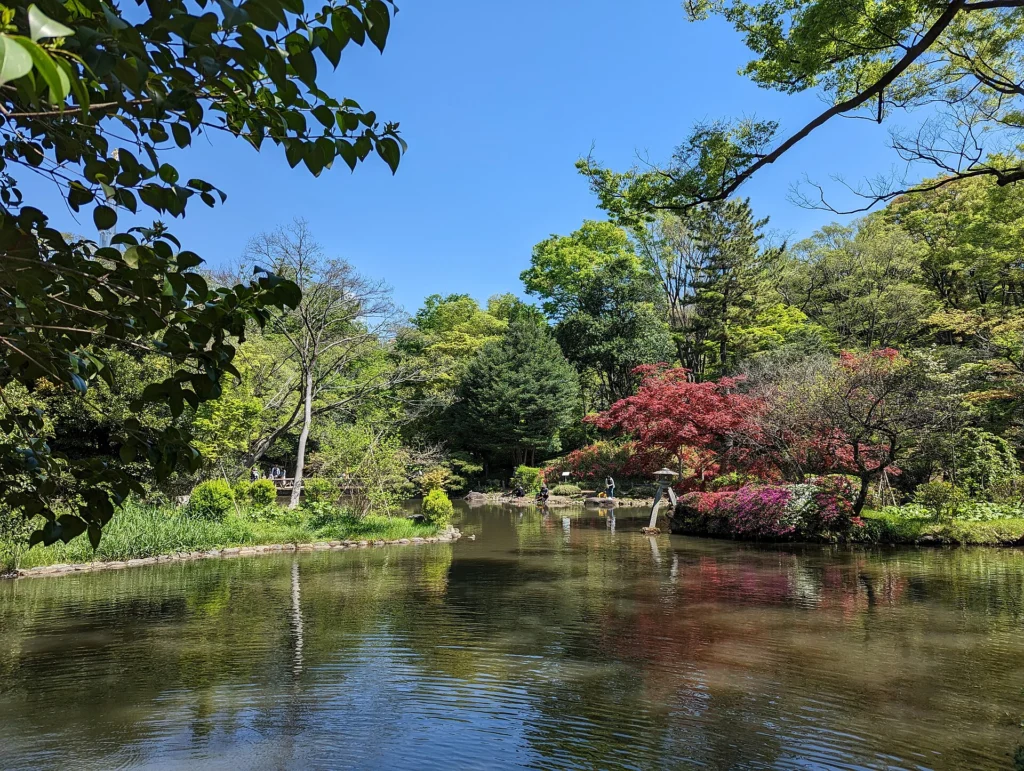
- The strolling garden: finished in 1934 and still close to how it looked then. The ground slopes from the high east side near the library down to the low west side, with hills, streams, a waterfall and a pond along the way.
- The pond: just inside the entrance on the Hiroo side. It has two small islands and stone lanterns. Water from the northeast falls as a waterfall and runs into it as a stream.
- Bridges and paths: a stone arched bridge and a zigzag plank bridge (yatsuhashi) cross the stream. Steps made of imitation log and earth paths remain from the park’s early days.
- Statue of Prince Arisugawa Taruhito: a bronze statue on horseback by Okuma Ujihiro, the symbol of the park. It was put up at Miyakezaka in 1903 and moved here in 1962, when the Metropolitan Expressway was built for the Tokyo Olympics.
- Other statues: a flute-playing boy by Funakoshi Yasutake, and a newspaper boy statue by Asakura Kyoko. The park says this was the first of the newspaper boy statues now found around Japan, unveiled here in May 1958.
- Wildlife: ducks on the pond and wild birds such as Japanese white-eyes and pygmy woodpeckers. Kingfishers sometimes come in winter.
Flowers by season
The park gives this rough guide, and notes that flowers have bloomed a little earlier in recent years: camellias in January, plum in February, cherry blossoms in March, azaleas and dogwood in April, wisteria and irises in May, hydrangeas from June, ginkgo and other autumn leaves in November, and sasanqua in December. Cherry blossoms last from mid-March to early April. On November 13, 2026, the park said the ginkgo leaves were turning a little yellow and the maples had not turned red yet.
Tips
- The park has no car park and no bicycle parking. Come by train or bus.
- The park office is on the east side of the plaza and has an AED. Ask there if you have a question.
- The play area on the high ground has a wooden play set, swings, slides, a jungle gym and a sandbox.
- The Tokyo Metropolitan Central Library opened in the park in 1973.
Getting there
- Hiroo Station (Tokyo Metro Hibiya Line): about 3 minutes on foot.
- Chii Bus (Minato City community bus), Azabu West route: Arisugawa-no-miya Kinen Koen stop, right at the park.
- Toei bus: Hashi 86 (Meguro-Shimbashi) to Hiroo-bashi or Aiiku Clinic, about 1 minute on foot. Kuro 77 (Meguro-Sendagaya) and Shina 97 (Shinagawa Garage-Shinjuku) to Hiroo-bashi, about 3 minutes on foot.
For more of the area, see our Azabu-Juban guide and our Roppongi and Azabudai guide. Ebisu is also close; read our Ebisu and Naka-Meguro guide. In autumn, compare it with other spots in our autumn leaves in Tokyo guide.
FAQ
Is Arisugawa-no-miya Memorial Park free?
Yes. The park is free to enter.
When are the autumn leaves best?
The park lists November for ginkgo and other autumn leaves. On November 13, 2026, the ginkgo leaves were starting to turn yellow and the maples had not turned red yet.
Is there parking?
No. The park has no car park and no bicycle parking, so come by train or bus.
What is the statue on horseback?
A bronze statue of Prince Arisugawa Taruhito by Okuma Ujihiro. It stood at Miyakezaka from 1903 and was moved to the park in 1962.
What is the nearest station?
Hiroo Station on the Tokyo Metro Hibiya Line, about 3 minutes on foot.
Keep reading
Sources
Facts come from Minato City’s official park page and the official website of the park’s designated manager (Minato City Azabu Parks), last checked on November 18, 2026. This page is based on official sources, not our own visit. Last checked: November 2026 (on November 18, 2026).